Infusing Authenticity into Digital Design: The Enduring Appeal of the Happy Rainbow Family Typeface
In the contemporary landscape of digital marketing and brand development, the tension between high-tech efficiency and genuine human connection is palpable. As artificial intelligence streamlines content creation and automation dictates our workflows, the demand for design elements that feel tactile, personal, and "imperfect" has skyrocketed. This shift is not merely an aesthetic preference; it is a strategic response to a market saturated with sterile, vector-based precision. Amidst this backdrop, Happy Rainbow Family has emerged as a significant typographic choice, offering a harmonious blend of playfulness and authenticity that resonates deeply with modern audiences.
The Anatomy of a Cheerful Trio
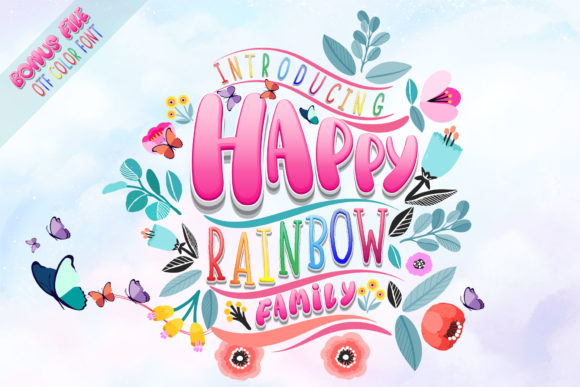
To understand the impact of this typeface, one must first deconstruct its composition. Happy Rainbow Family is not a singular font but a curated trio comprising display, serif, and script variations. This tripartite structure is crucial for its versatility. The display font commands attention with its bold, bubbly characteristics, ideal for headlines that need to exude energy. The serif component grounds the design, offering a nod to traditional readability while maintaining a soft, approachable edge. Finally, the script element introduces a handwritten fluidity that mimics the spontaneity of a marker or crayon.
Together, these three styles create a complete visual language. They allow designers to construct a hierarchy of information—headlines, subheadings, and body text—without needing to source typefaces from different families, which often leads to visual discord. The cohesion of Happy Rainbow Family ensures that whether a user is scanning a poster or reading a digital invitation, the experience feels unified and intentional.
Contextualizing the Trend: Why "Imperfection" is the New Premium
The rise of Happy Rainbow Family aligns with a broader industry movement often referred to as "Anti-Design" or "New Simplicity." For years, the web was dominated by the "Corporate Memphis" style—flat, geometric illustrations and rigid sans-serif typography. However, consumers, particularly Millennials and Gen Z, have begun to tune out these polished corporate signals. They crave authenticity.
This preference has birthed a resurgence in materials that feel handmade. In the realm of typography, this translates to fonts that possess texture, irregular baselines, and organic curves. Happy Rainbow Family fits perfectly into this niche. It bridges the gap between professional production and a DIY aesthetic. It signals to the viewer that the brand behind the content is approachable, creative, and focused on human-centric values rather than cold corporate efficiency.
Practical Applications: Beyond the School Project
While the inherent charm of Happy Rainbow Family makes it the perfect choice for children's activities or school projects, its utility extends far beyond the classroom. Forward-thinking professionals are integrating this typeface into diverse sectors to soften their messaging and increase engagement.
1. Marketing and Brand Strategy
For entrepreneurs and freelancers, differentiation is survival. A brand identity utilizing Happy Rainbow Family immediately stands apart in a feed of minimalist black-and-white competitors. Consider a local artisan bakery or a boutique children’s clothing line. By using the display variant for their logo and the script variant for social media overlays, they communicate warmth and handmade quality before the customer even tastes the product or touches the fabric. It is a visual shortcut to trust.
2. User Interface (UI) and Experience Design
In the tech space, there is a growing movement to humanize software. "EdTech" platforms and family-oriented apps are moving away from cold, robotic interfaces. Using a legible, friendly serif or a soft display font like those found in the Happy Rainbow Family can reduce user anxiety. When a child (or an adult) interacts with an interface that feels like a friendly invitation rather than a command, engagement metrics invariably rise.
3. Event Management and Lifestyle
The gig economy and the creator economy have led to a boom in personal branding for events. From wedding invitations to community workshop flyers, the need for typography that feels celebratory is high. Happy Rainbow Family embodies this celebration. Its "cheery" disposition makes it ideal for calls to action (CTAs). A button on a website inviting users to "Join the Fun" rendered in this font carries a psychological weight of excitement that a standard Arial or Helvetica button simply cannot match.
Adapting to Modern Workflows
One of the reasons professionals are paying attention to Happy Rainbow Family is its adaptability to modern, fast-paced workflows. In the past, achieving a cohesive look required mixing and matching fonts, testing for kerning issues, and ensuring x-heights matched. This was a time-consuming process.
By offering a pre-matched trio, this font family solves a common friction point for busy creators. A freelance designer working on a tight deadline for a client presentation can utilize Happy Rainbow Family to build a complete slide deck in minutes. They can use the bold display for slide titles, the serif for bullet points, and the script for accent quotes. This ensures the presentation looks polished and bespoke without the hours of typographic experimentation usually required.
The Psychology of Color and Typography
It is impossible to discuss Happy Rainbow Family without acknowledging the psychological implications of its namesake. "Rainbow" implies spectrum, inclusivity, and diversity. In today’s market, brands are expected to be inclusive. A typeface that visually suggests a spectrum of colors and joy helps brands position themselves as welcoming to all demographics.
Furthermore, the "playfulness" of the font serves as a counter-balance to the seriousness of the current global news cycle. Marketing professionals understand that escapism is a powerful tool. Content that utilizes Happy Rainbow Family offers a micro-dose of dopamine to the viewer. It suggests lightheartedness and optimism—qualities that are highly monetizable in the wellness, lifestyle, and family sectors.
Technical Considerations and Best Practices
For the discerning creator, using a display and script font requires discipline. Because Happy Rainbow Family is rich in character, it should be used strategically to avoid overwhelming the viewer. Here are a few professional insights for implementation:
- Hierarchy is King: Use the Display variation strictly for high-impact moments. Do not set entire paragraphs in the display font, as it will destroy readability.
- Contrast with Neutrals: The vibrancy of Happy Rainbow Family pairs best with clean, neutral sans-serifs for body text if the built-in serif feels too decorative for long-form reading.
- Color Palette Synergy: This font thrives in color. While it works in monochrome, pairing it with pastel palettes or bold, primary color blocks enhances its authentic, cheerful nature.
Conclusion: A Tool for Human Connection
In an era where digital content is often ephemeral, the choice of typography can anchor a message in the mind of the consumer. Happy Rainbow Family is more than just a collection of glyphs; it is a design strategy. It represents a pivot toward visual empathy, acknowledging that even in professional settings, we are communicating with humans who appreciate joy and authenticity.
Whether you are a marketer looking to soften a brand voice, a teacher designing engaging educational materials, or an entrepreneur building a community-first platform, Happy Rainbow Family offers a robust, versatile, and emotionally resonant solution. It proves that in the world of design, happiness is not just a feeling—it is a font choice.