Evaluating the Simple People Slab Serif for Your Next Design Project
Understanding the Core Characteristics of Simple People
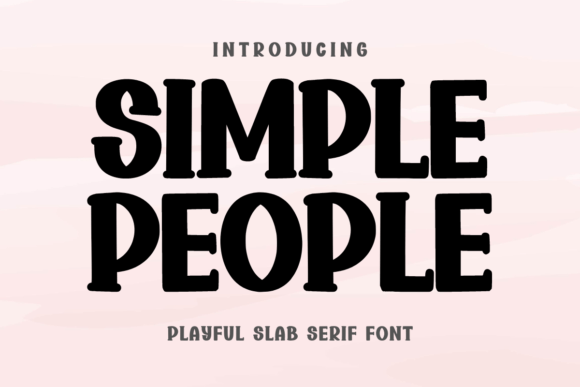
In the expansive world of typography, selecting the right typeface often requires balancing personality with functionality. Simple People is a design asset that leans heavily into personality, categorized as a thick and playful slab serif. Unlike the rigid, industrial feel of many traditional slab serifs, this font embraces a softer, more geometric construction. Its defining features include wide character widths and chunky serifs, which create a substantial visual footprint on the page or screen.
When you look at Simple People, the immediate impression is one of weight and stability. The "slab" element refers to the square or rectangular terminals at the end of strokes, but here, they are rendered with a rounded or playful approach. This distinguishes it from the harshness of typewriter-style fonts. The wide stance of the letters ensures high legibility at a glance, making it a strong contender for environments where text competes for attention against other visual elements.
Analyzing the Visual Impact and Structure
The structure of Simple People is designed to command attention. The thick strokes provide high contrast against backgrounds, which is a critical factor in display typography. Because the characters are wider than average, the font creates a sense of openness and approachability. This is particularly useful in branding contexts where a company wants to appear accessible rather than exclusive or overly formal.
However, this distinct structure comes with specific technical considerations. The wide character width means that Simple People occupies more horizontal space than condensed or standard-width fonts. Designers must account for this when planning layout grids, as headlines may wrap more frequently than expected if space is limited. It is a font that requires room to breathe to function effectively.
Practical Applications: Where Simple People Excels
The utility of Simple People is most evident in applications requiring high visual impact. It is specifically engineered for headlines, t-shirt typography, banners, and product labels. In these scenarios, the font’s playful nature adds a layer of energy to the design.
For instance, in t-shirt typography, legibility and style are paramount. Simple People offers a balance that allows for expressive designs that remain readable from a distance. Similarly, for product labels—particularly in food, beverage, or lifestyle sectors—the chunky serifs and rounded edges convey a friendly, organic, or artisanal quality.
Comparing Display Fonts: Bold vs. Playful
When evaluating options for a project, it is helpful to compare the characteristics of Simple People against other display font categories. Many designers find themselves choosing between a "bold" aesthetic and a "playful" one.
- Industrial Slab Serifs: Fonts in this category often feature sharp corners and uniform stroke widths. They project strength and reliability, often used in construction or automotive branding. Simple People offers a softer alternative, making it better suited for lifestyle brands than heavy industry.
- Rounded Sans-Serifs: While also playful, rounded sans-serifs lack the distinct terminals of a slab serif. Simple People provides more texture and visual interest due to its serifs, giving it a more "retro" or "vintage" feel compared to the modern simplicity of a sans-serif.
- Hand-Lettered Scripts: Scripts offer personality but often suffer from legibility issues at small sizes or on busy backgrounds. Simple People maintains the whimsical feel of lettering but adheres to a structured grid, ensuring consistency and readability.
Evaluating Strengths and Tradeoffs
No typeface is a universal solution, and understanding the tradeoffs of Simple People is essential for a professional workflow. The primary strength of this font is its ability to establish a tone instantly. It removes the need for complex illustrations to convey friendliness; the typeface itself does the work.
The tradeoff, however, lies in versatility. Because Simple People has such a strong voice, it is difficult to use in neutral or corporate contexts. It would likely feel out of place on a banking website or a legal document. Furthermore, the thick strokes that make it great for headlines can cause "clogging" if used in body text, reducing readability in long paragraphs.
Decision Factors for Designers
When deciding whether to incorporate Simple People into your toolkit, consider the following factors:
- Target Audience Age: The playful, wide nature of the font resonates well with younger demographics (Gen Z and Millennials) or family-oriented markets. It may feel too casual for audiences expecting traditional sophistication.
- Medium of Delivery: Simple People performs exceptionally well in print-on-demand and digital display. However, in very small digital sizes, the thick serifs might render poorly on low-resolution screens.
- Brand Personality: Does the brand voice need to sound loud, fun, and energetic? If yes, this font is a strong match. If the brand needs to sound quiet, elegant, or serious, a different style is required.
Navigating Alternatives and Variations
If Simple People feels close to what you need but isn't quite right, there are several avenues to explore. Understanding these alternatives helps in making a final decision.
One common variation in this category is the "Grotesque" slab serif, which blends humanist curves with slab terminals. If the "playful" aspect of Simple People feels too cartoonish for your project, a grotesque variant might offer the weight you need with a slightly more serious tone. Conversely, if you need even more personality, you might look toward hand-drawn slab serifs that include irregular edges and textures.
Comparing Formats and Tools
When sourcing fonts like Simple People, you will encounter various file formats and licensing models. While the visual style is the priority, the technical compatibility is a practical necessity.
- Variable Fonts vs. Static Files: Some modern typefaces offer variable axes for weight and width. If Simple People is available as a variable font, it allows for more dynamic adjustments within a single file. If it is a static font family, you will need to swap files to change weights.
- Web vs. Desktop Licensing: Ensure that the license for Simple People covers your specific use case. A license for a t-shirt design (print) is different from a license for a high-traffic website (webfont).
- Kerning and Spacing: Given the wide nature of the characters, check the default kerning pairs. Wide fonts sometimes require manual adjustment in logos to ensure the spacing between letters feels even, as optical illusions can make wide letters look further apart than they are.
Integrating Simple People into Design Systems
For designers building a cohesive design system, the introduction of a display font like Simple People requires a supporting cast. Because the display font is so expressive, the accompanying body text font should be neutral and highly legible.
A common pairing strategy involves using Simple People for H1 and H2 headings, while utilizing a clean, geometric sans-serif (like a standard sans-serif) for body copy. This creates a hierarchy where the "voice" of the brand is heard in the headlines, while the "information" is delivered clearly in the text. Using Simple People for both would overwhelm the reader and dilute the impact of the headlines.
Best Fit Scenarios
To summarize the evaluation, Simple People is the right choice when:
- You are designing merchandise, specifically apparel where text is the primary graphic.
- The project involves children's products, food packaging, or casual branding.
- You need a font that works well at large scales on banners or signage.
- The design calls for a "retro" or "vintage" vibe without being overly distressed.
Conversely, you may need to look elsewhere if you are designing a luxury magazine, a corporate annual report, or a user interface for a data-heavy dashboard. In those contexts, the wide footprint and heavy weight of Simple People would hinder the user experience.
Conclusion on Evaluation
Choosing a typeface is ultimately about fit. Simple People