Evaluating Bold Display Fonts: A Practical Look at Combe and Proske Drawn
Choosing the right typeface for a project is a critical decision that balances aesthetic appeal with functional communication. For designers and creators working on branding, posters, or digital media that demands immediate visual impact, the category of bold, characterful display fonts is essential. Within this space, Combe and Proske Drawn presents itself as a distinct option worth evaluating. This article provides a practical analysis of its characteristics, ideal applications, and how it fits within the broader landscape of expressive typography.
Understanding the Core Identity of Proske Drawn
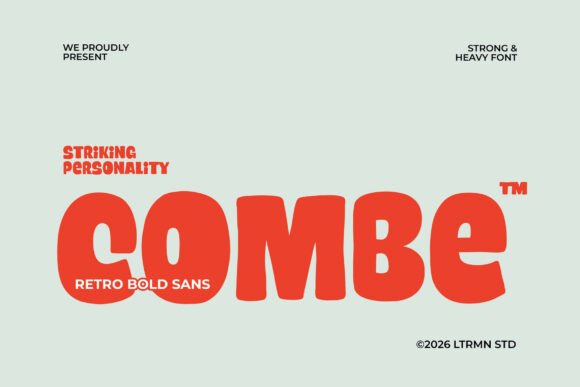
At its heart, Proske Drawn is a funky, bold display typeface designed for high-energy contexts. Its defining feature is a deliberately irregular, hand-drawn aesthetic combined with chunky, substantial letterforms. This is not a font for setting body text or requiring precise, uniform clarity. Instead, its character comes from subtle variations in line weight, slightly uneven baselines, and playful, often asymmetric shapes. The "drawn" quality suggests an organic, human touch, setting it apart from more geometric or mechanically perfect bold fonts. It’s designed to inject personality and a sense of dynamic movement into a headline or logo.
Key Design Features and Practical Implications
The feature set of Proske Drawn is tailored for versatility in creative applications. It includes both uppercase and lowercase letters, which is crucial for avoiding an all-caps monotone and allowing for more nuanced typographic hierarchies. The inclusion of numbers and a standard punctuation set ensures it can handle most headline-level text requirements. A notable feature is the inclusion of ligatures and stylistic alternates. These are not mere extras; they are tools that allow designers to customize the look of specific letter pairs or characters, enhancing the handwritten feel and preventing repetitive patterns that can break the illusion of organic flow.
In terms of file formats, Proske Drawn is provided as OTF, TTF, WOFF, and WOFF2. This standard bundle covers most use cases: OTF and TTF for desktop design software and print, while WOFF and WOFF2 are optimized for web use, ensuring fast loading times and broad browser compatibility. This makes the font a practical choice for projects that span both print and digital media.
Situational Fit: When to Choose Proske Drawn
The strengths of Proske Drawn are most apparent in specific scenarios. It is an excellent candidate for projects where the primary goal is to stand out and convey a sense of fun, energy, or informality. Think of branding for a children’s product, a music festival poster, a trendy café menu, or the title sequence for a playful animated video. Its bold weight ensures readability at a glance from a distance, while its funky details reward closer inspection. In these contexts, the font does more than just label; it communicates an immediate emotional tone.
Furthermore, the inclusion of alternates makes Proske Drawn particularly useful for creating unique logos or lockups. By swapping in different letter shapes, a designer can craft a wordmark that feels truly one-of-a-kind, avoiding the common issue of a font being instantly recognizable from a popular template. This customization potential is a significant advantage for branding work that requires a distinctive signature.
Tradeoffs and Limitations to Consider
No typeface is universal, and Proske Drawn comes with clear tradeoffs. Its greatest strength—its irregular, funky character—can be a limitation in contexts demanding neutrality or seriousness. Using it for a law firm’s website, a financial report, or medical documentation would be inappropriate and undermine credibility. The very features that make it lively can make it difficult to read in long sentences or at small sizes, where its uneven forms can cause visual fatigue.
Compared to more conventional bold sans-serifs, Proske Drawn sacrifices a degree of clean scalability for personality. A geometric bold font will maintain perfect consistency and legibility across a massive billboard and a tiny mobile app icon. Proske Drawn’s hand-drawn details may become muddled or lost at very small sizes, and its irregular spacing might require more manual kerning for optimal results. Designers must be willing to invest time in fine-tuning its application to get the best outcome.
Exploring Alternatives and Complementary Approaches
When evaluating Proske Drawn, it’s wise to consider the category it belongs to. Alternatives might include other bold, quirky display fonts, but with different stylistic flavors—perhaps more retro, more graffiti-inspired, or more geometrically playful. The key is to compare the specific character of the irregularity. Is the “drawn” quality wobbly, rough, or smooth? Does it feel vintage or modern? These nuances matter for aligning the font with a project’s specific vibe.
A practical approach is to pair Proske Drawn with a highly legible, neutral font for any supporting text. For instance, using Proske Drawn for a main headline and a clean sans-serif like Open Sans or a readable serif for body copy creates a balanced design that is both impactful and functional. This pairing strategy leverages the font’s strengths for attention-grabbing while mitigating its weakness for extended reading.
Making an Informed Decision
Ultimately, choosing Combe and Proske Drawn comes down to a clear-eyed assessment of your project’s needs. Ask yourself: Is the primary goal to evoke energy, fun, and a handcrafted feel? Is the application limited to headlines, logos, or short, impactful phrases? If yes, then its bold, funky character could be a perfect match. It’s a tool for making a statement, not for blending in.
Conversely, if your project requires versatility across many contexts, long-form readability, or a tone of formal authority, other typeface categories will serve you better. The value of Proske Drawn lies in its specialization. By understanding its designed purpose—creating bold, playful, and visually striking designs—you can deploy it effectively where it shines, ensuring it adds genuine character rather than becoming a distraction. Always test it within your specific design context, alongside your chosen color palette and imagery, to see if the collective energy aligns with your communication goals.